
The best time to visit Austin is late March to mid-May and late September to November, when average highs sit between 72 and 87 °F (22 to 30 °C) and the city lives outdoors. The stretch to avoid is July and August: the August average high is 97 °F (36 °C) and Austin's official station at Camp Mabry averages 29 days a year at or above 100 °F in the 1991 to 2020 normals. Two weeks also break the rate card rather than the weather: SXSW in March and the ACL and Formula 1 run in October. Everything below is month by month, with dates and sourced figures. Start with our Austin hotel guide.
The short answer
- Best overall: late March to mid-May, then late September through November.
- Hottest month: August, average high 97 °F (36 °C). Coolest: January, 62 °F (17 °C) by day and 38 °F (3 °C) at dawn.
- Two rainy peaks, not one: May at 5.0 in (127 mm) and October at 4.3 in (108 mm). February is the driest month at 1.9 in (48 mm).
- Cheapest and quietest: January and early February, and midsummer once the heat sets in.
- Most expensive: SXSW week, March 15 to 21, 2027, and October, which carries both ACL weekends and the Grand Prix.
- Bluebonnets in the Hill Country bloom from late March, with peak bloom in early April.
- The bats under Congress Avenue Bridge are in residence from mid-March to early November, at their largest in August.
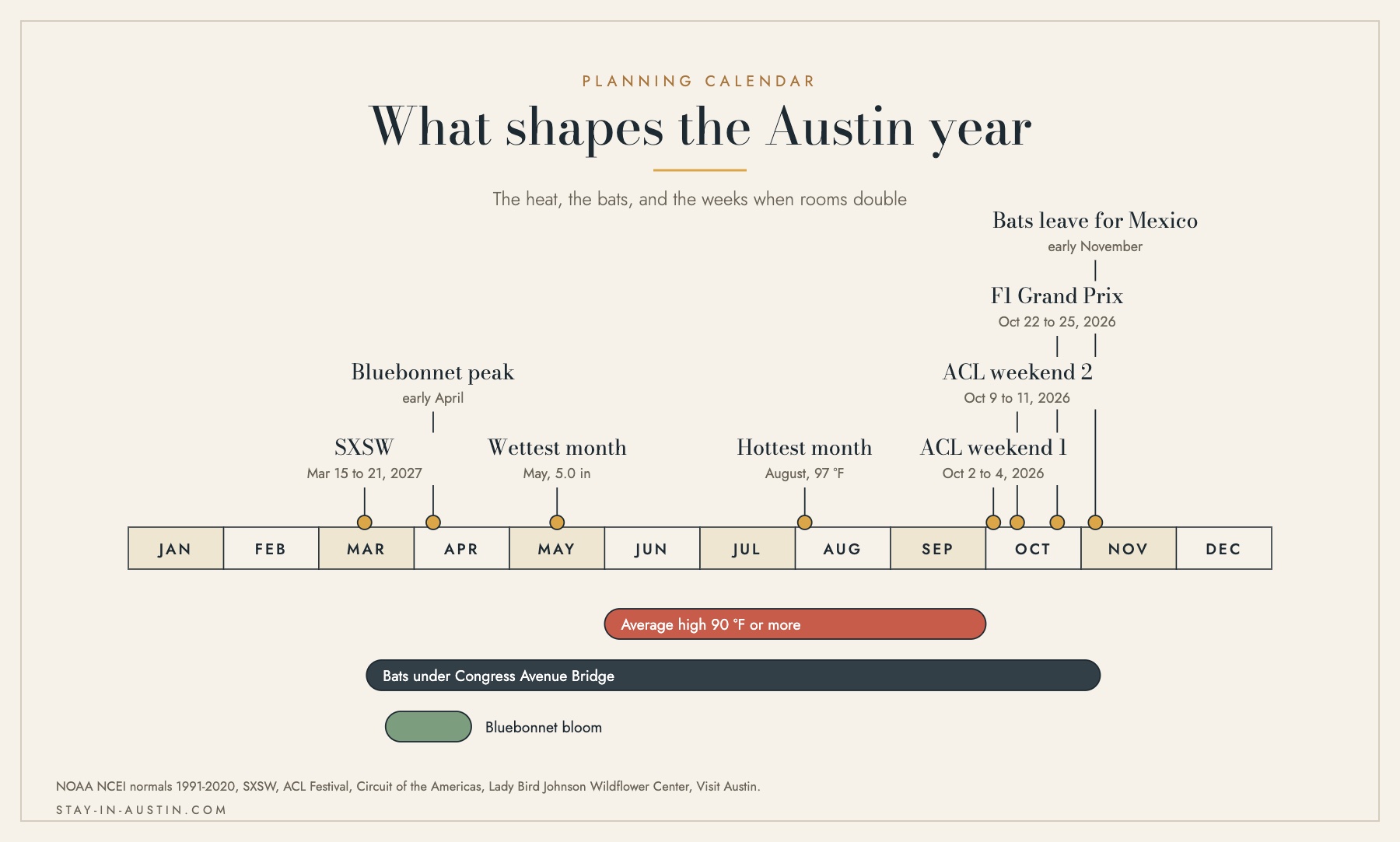
The Austin planning calendar: the heat, the bats, the bluebonnets and the weeks when rooms double.
Understanding the climate in Austin
Austin has a humid subtropical climate on the edge of the Texas Hill Country, which in practice means a long hot core and short shoulders. Five months of the year, from May through September, carry an average high of 87 °F (30 °C) or more. Four of those sit at 91 °F (33 °C) or above. The National Oceanic and Atmospheric Administration's 1991 to 2020 normals for Austin-Bergstrom International Airport put August at the top, 97 °F (36 °C) by day and 73 °F (23 °C) at night, and the overnight low never drops below 71 °F (22 °C) from June to August. That is the figure that decides a summer trip: the night does not cool down.
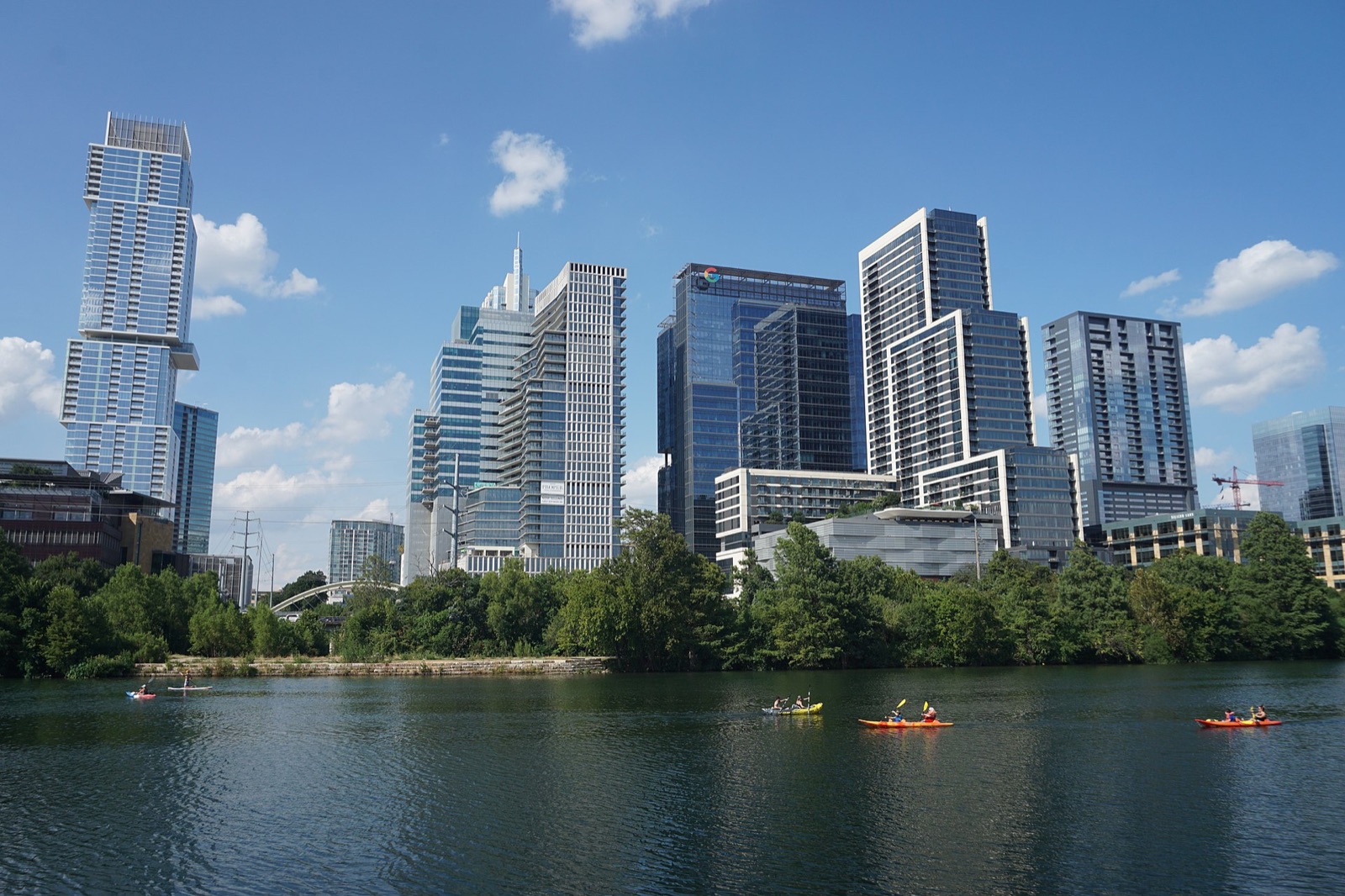
Downtown Austin from Lady Bird Lake. The hike-and-bike trail is the city's outdoor room, and it is only usable early and late from June to September. Photo : Michael Barera, Wikimedia Commons, CC BY-SA 4.0.

One number gets quoted more than any other. At Camp Mabry, Austin's official National Weather Service station in the middle of the city, the 1991 to 2020 average is 29 days a year at or above 100 °F (38 °C). Those days are concentrated in July and August, and the historical trend is upward: the long-run average from 1898 onward is closer to 16.
Rain comes twice a year, in spring and in fall
Austin does not have a monsoon or a dry season. It has two wet peaks separated by a dry core. May is the wettest month at 5.0 in (127 mm) over 5.1 rain days, delivered by spring thunderstorms that can be violent and brief. October is the second peak at 4.3 in (108 mm). Between them, July takes 2.2 in (55 mm) and August 2.5 in (63 mm), and August has the fewest rain days of the year at 2.8. The annual total is 35.6 in (905 mm) over about 47 rain days, counting any day with 0.1 in (2.5 mm) or more.
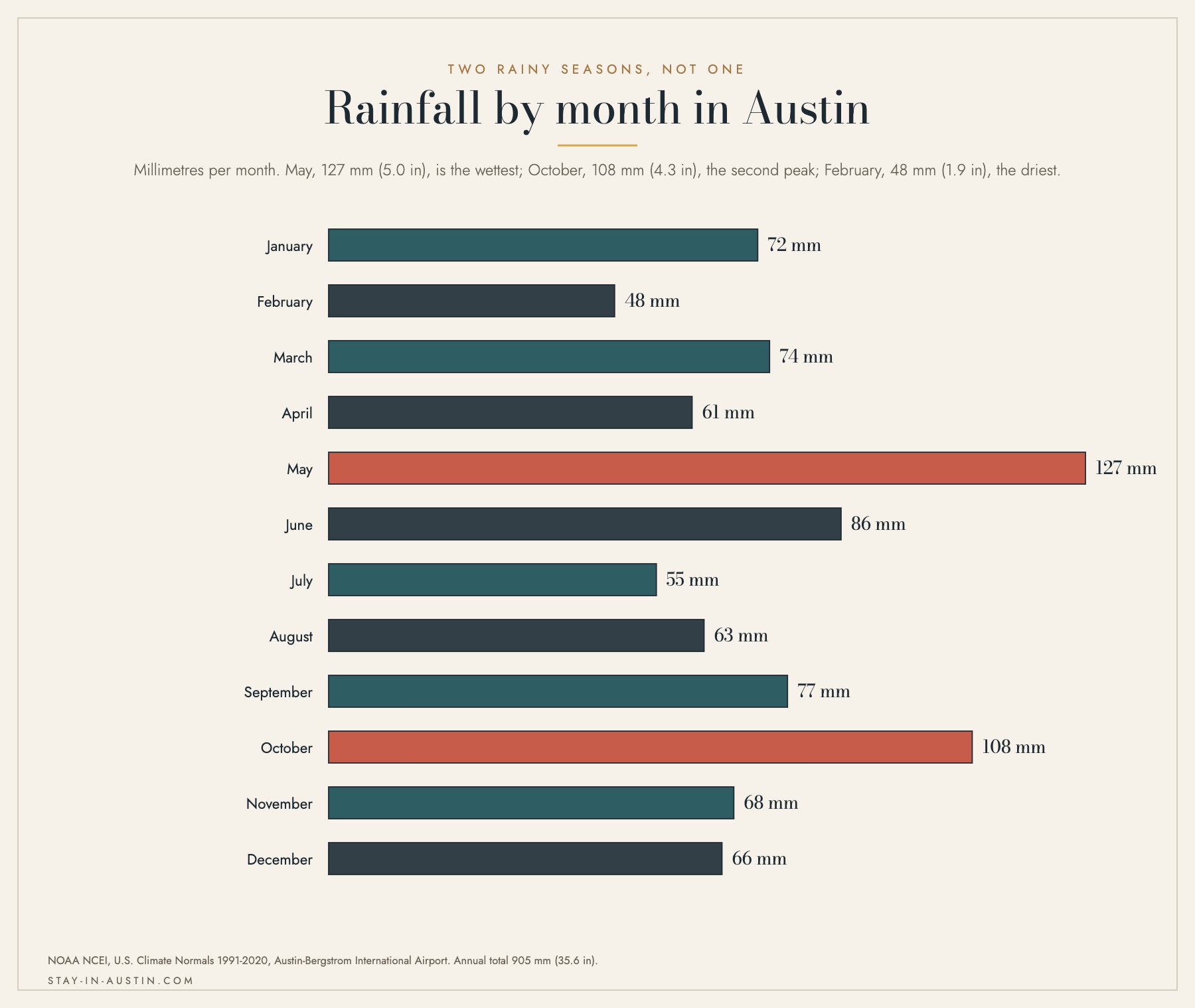
Austin has two rainy peaks, in May and October, with the driest days falling in midsummer.
Snow is not part of the picture. The 1991 to 2020 normals record no snowfall in any month at Austin-Bergstrom. The genuine winter risk in Central Texas is ice: the freezing rain of January 31 to February 2, 2023 left more than 170,000 Austin Energy customers without power, with three quarters of an inch of ice accumulation bringing down trees and lines. It is rare, but it is the reason a February booking should be flexible.
Spring in Austin, March to May
Spring is the shortest and best-looking season. The average high climbs from 73 °F (23 °C) in March to 80 °F (27 °C) in April and 87 °F (30 °C) in May. Nights are still usable: 49 °F (9 °C) in March, 56 °F (13 °C) in April. April is the sweet spot, warm enough for the lake and cool enough to walk the Capitol grounds at midday.
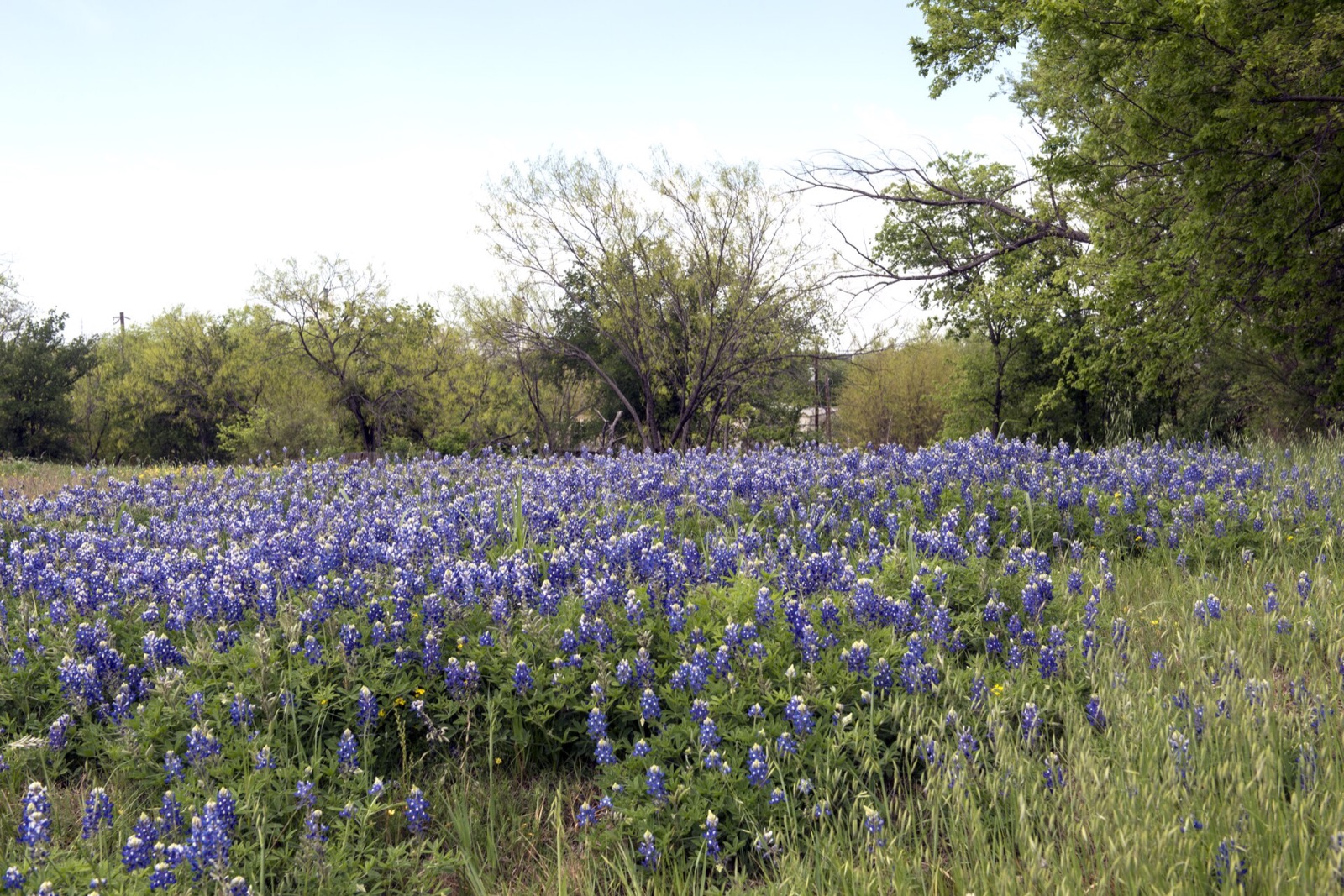
Bluebonnets near Marble Falls, in the Hill Country northwest of Austin. Peak bloom is in early April. Photo : Carol M. Highsmith, Wikimedia Commons, Public domain.
It is also wildflower season, which is a genuine reason to come in April rather than October. Bluebonnets, the Texas state flower, start blooming in Central Texas toward the end of March; the Lady Bird Johnson Wildflower Center puts peak bloom in early April, with the window running roughly two to three weeks. The drives that matter are west and north of the city, toward Marble Falls, Burnet and Llano, and the Wildflower Center itself sits in south Austin. Our Hill Country day trips cover the routes.
Three things to plan around in spring:
- SXSW runs March 15 to 21, 2027. It is the single most expensive week of the Austin year. During SXSW 2024, the Austin American-Statesman reported 114,933 hotel room nights occupied in downtown Austin alone at an average daily rate of $423.95. If you are not attending, move your dates.
- May is the wettest month. Spring storms in Central Texas are convective: heavy, short and often severe. Build a fallback into any all-day outdoor plan in May.
- Bloom timing moves with the winter rain. The bluebonnet window shifts by a week or two from year to year, and a dry winter shortens it. Check the Wildflower Center before committing a whole day to a drive.
Summer in Austin, June to September
This is the long season, and it is genuinely hot. June averages 93 °F (34 °C), July 96 °F (36 °C), August 97 °F (36 °C), and September still holds 91 °F (33 °C). Humidity keeps the overnight low at 71 to 73 °F (22 to 23 °C) through the core months. Summer is also the quietest and cheapest stretch outside the winter, which is the trade on offer.
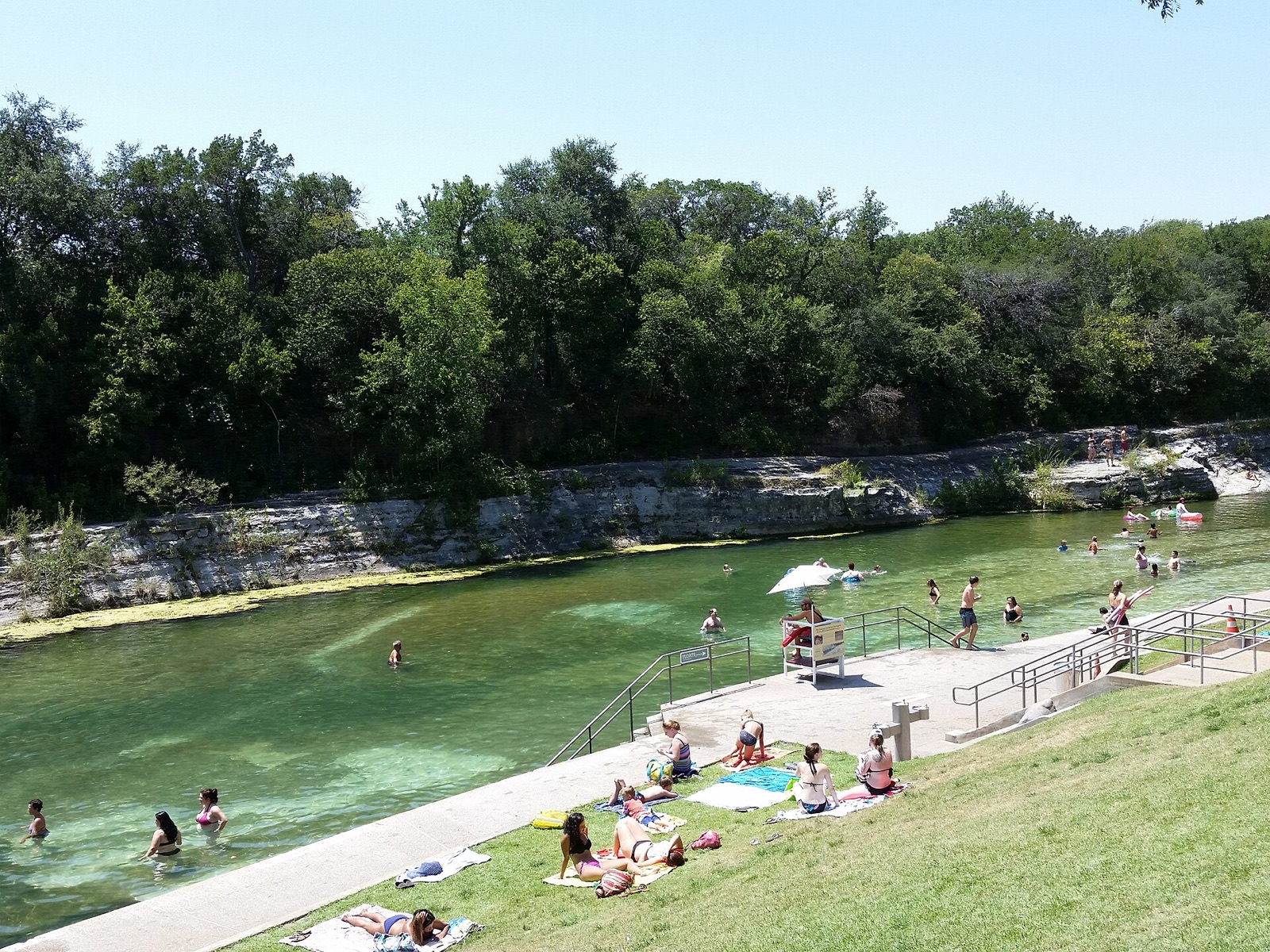
Barton Springs Pool, Zilker Park. Spring-fed at 68 to 70 °F (20 to 21 °C) all year, which is the whole argument for an Austin summer. Photo : Wordandgesture, Wikimedia Commons, CC BY-SA 3.0.

Austin is built for it better than most Texan cities, because it has spring-fed water in the middle of town. Barton Springs Pool, in Zilker Park at 2201 William Barton Drive, is fed by underground springs that hold 68 to 70 °F (20 to 21 °C) all year. The City of Austin opens it from 5 a.m. to 10 p.m., with a Thursday closure from 9 a.m. to 7 p.m. for cleaning; since March 21, 2026, admission is $5 for residents and $9 for non-residents, and $2 to $4 for children.
How to handle an Austin summer day:
- Do the outdoor thing before 10 a.m. or after 7 p.m. The hike-and-bike trail around Lady Bird Lake is a different experience at those two hours than at 3 p.m.
- Book a hotel with real shade or real water. A rooftop pool that bakes from noon is not a cooling strategy. Our guide to surviving Austin's summer sorts the pools, the spring-fed swims and the lake escapes.
- Use the bats. August is when the Congress Avenue colony is at its largest, and the emergence happens at dusk, which is the only comfortable hour anyway.
- Expect the fewest rain days of the year in August, at 2.8. This is not a season that gets rained out; it gets heat-stroked out.
- September is the underrated month. The heat breaks in the second half, the festivals have not started, and rates have not yet moved. Our September booking strategy makes the case in detail.
If you are traveling with children in July, the practical question is which hotel turns the heat into a feature rather than a problem, which our page on keeping kids cool in Austin answers property by property.
Fall in Austin, late September to November
The turn comes in the first half of October. October averages 83 °F (28 °C) by day and 57 °F (14 °C) at night; November settles to 72 °F (22 °C) and 47 °F (8 °C). October is also the second rain peak of the year, at 4.3 in (108 mm) over 4.3 days, so an outdoor festival weekend is not a guaranteed dry one.
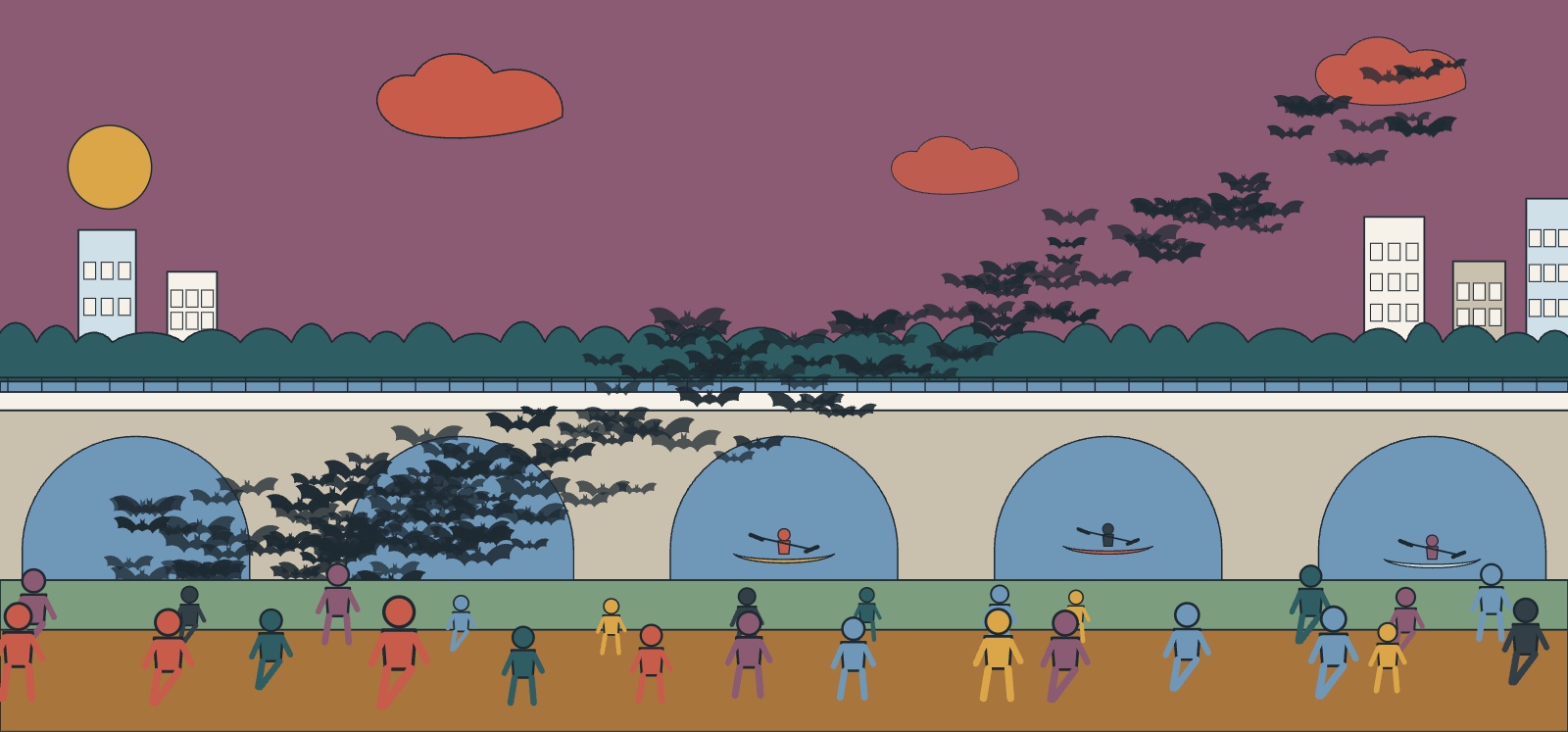
The Congress Avenue Bridge colony emerges at dusk from mid-March to early November, at its largest in August. Illustration : Discover Austin's Luxury Hotels: Book Premium Stays Online.
October is when Austin is most itself and most expensive. Austin City Limits takes over Zilker Park across two weekends, October 2 to 4 and October 9 to 11, 2026, with gates from 11 a.m. to 10 p.m. and an attendance of about 450,000 across the six days. Three weeks later the Formula 1 United States Grand Prix runs at Circuit of the Americas, October 22 to 25, 2026. KXAN reported the citywide average room price for the October 2024 run of those events at $477 a night, with occupancy expected at 80 to 90 percent, against a citywide annual occupancy of roughly 63 percent in 2025.
November is the quiet reward. The weather is at its most pleasant, the festivals are over, and the rates come back down. If you want Austin's fall without its crowd, that is the month. Our pool season into fall guide covers the properties where outdoor space still works in November.
Winter in Austin, December to February
Winter in Austin is mild and cheap rather than cold. December averages 64 °F (18 °C) by day, January 62 °F (17 °C) and February 66 °F (19 °C). Nights drop to 38 to 42 °F (3 to 6 °C). February is the driest month of the year at 1.9 in (48 mm) over 3.1 rain days.
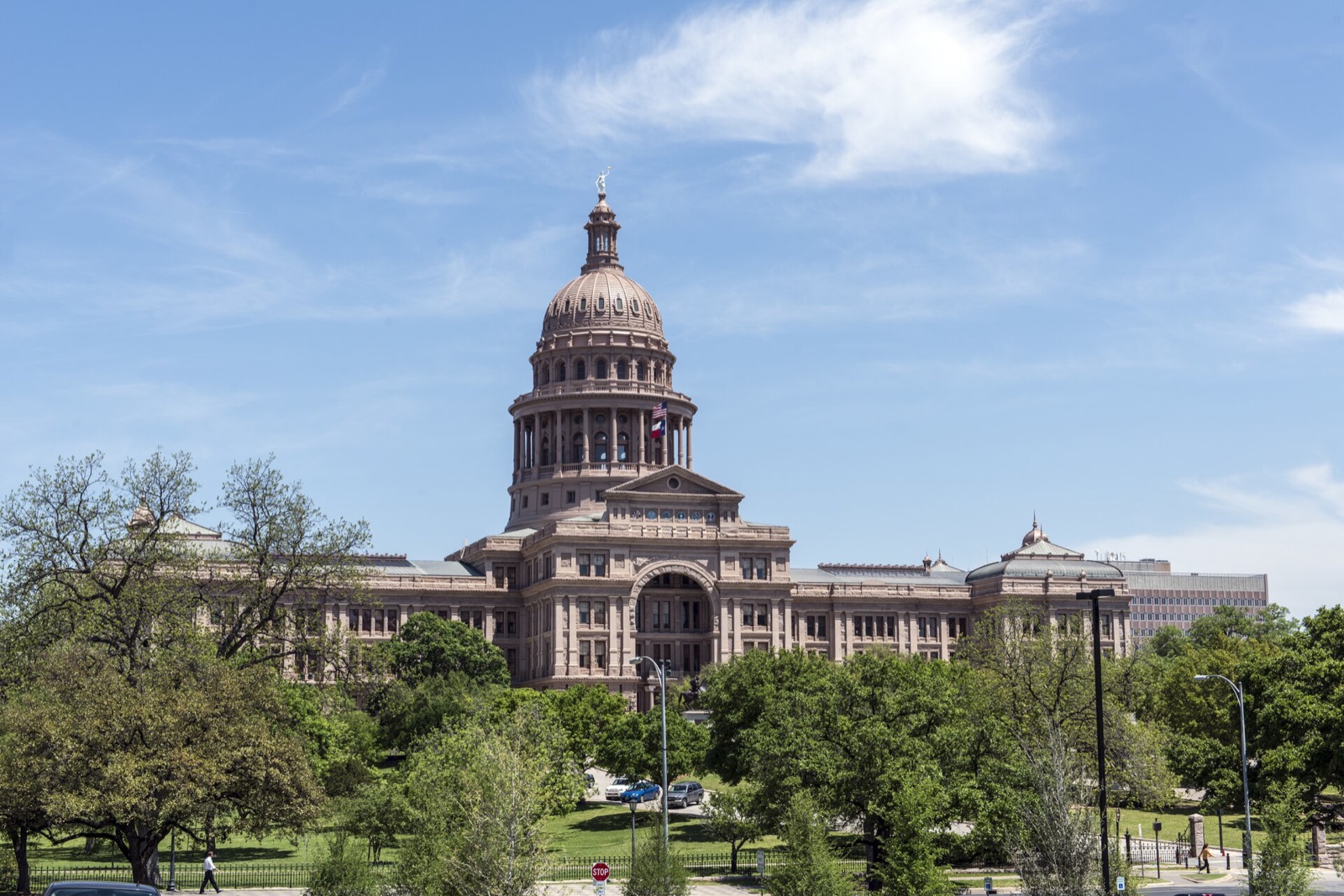
The Texas State Capitol. Winter is when the indoor city and the grounds are at their most comfortable. Photo : Carol M. Highsmith, Wikimedia Commons, Public domain.
That combination makes January the best value window in the calendar. The indoor city is at full strength: the Texas State Capitol and its grounds, the Blanton Museum, the Bullock Texas State History Museum, the barbecue queues that are unbearable in August. Live music does not have a season in Austin, and a January Tuesday on Red River is a better night out than a March one, for the simple reason that you can get in.
The caveat is ice, not cold. Central Texas freezing rain events are rare and disruptive, and the February 2023 storm is the reference: more than 170,000 Austin Energy customers lost power, some for days. Book refundable rates in late January and February and watch the forecast in the week before travel.
Austin month by month
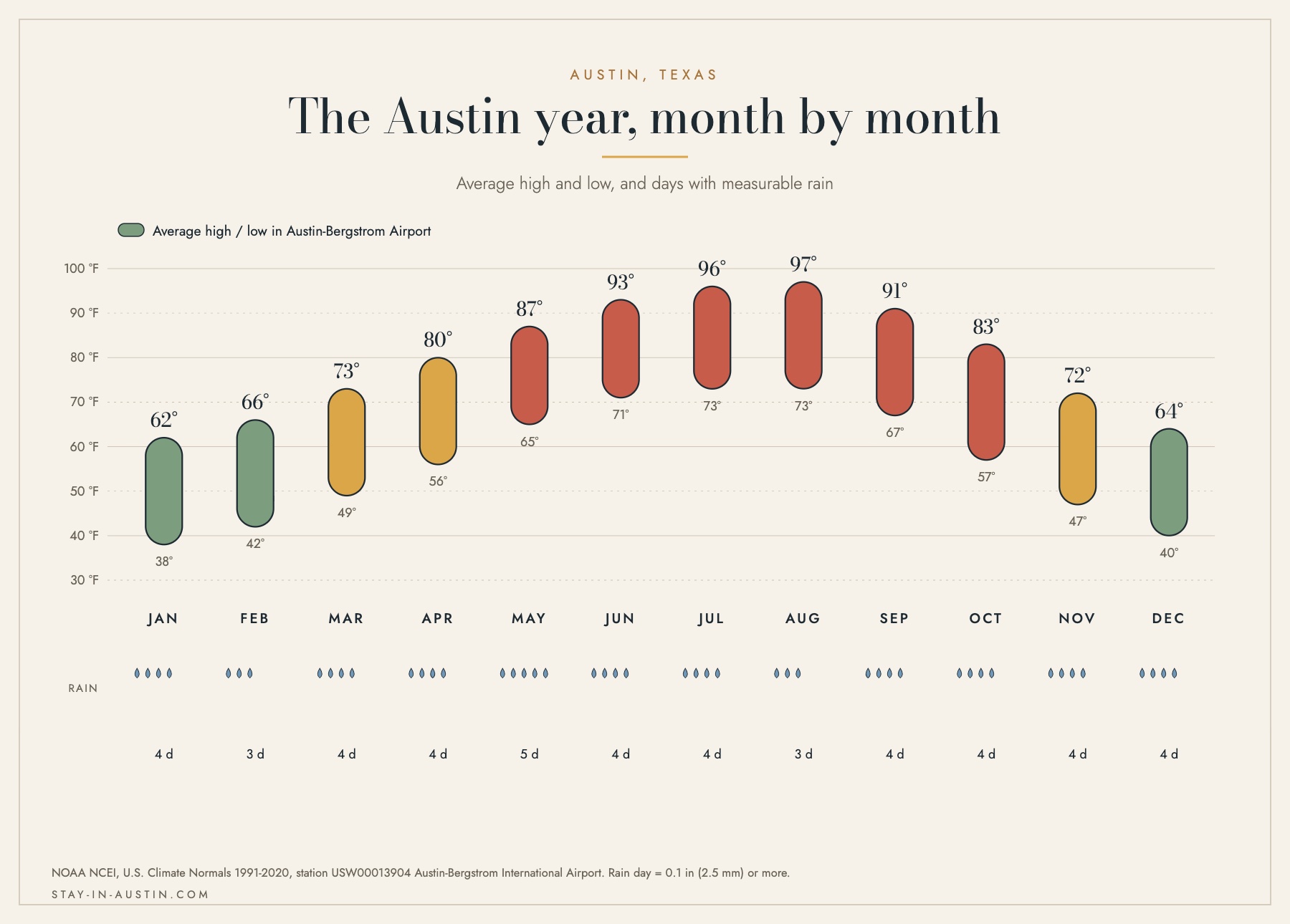
Austin month by month: average high, average low and rain days, from the NOAA 1991 to 2020 normals.
| Month | Avg high | Avg low | Rain | Rain days | Verdict |
|---|---|---|---|---|---|
| January | 62 °F / 17 °C | 38 °F / 3 °C | 2.8 in / 72 mm | 4.2 | Cheapest, mild, indoors |
| February | 66 °F / 19 °C | 42 °F / 6 °C | 1.9 in / 48 mm | 3.1 | Driest, good value, ice risk |
| March | 73 °F / 23 °C | 49 °F / 9 °C | 2.9 in / 74 mm | 4.2 | Lovely, but SXSW week |
| April | 80 °F / 27 °C | 56 °F / 13 °C | 2.4 in / 61 mm | 4.2 | Best month, wildflowers |
| May | 87 °F / 30 °C | 65 °F / 18 °C | 5.0 in / 127 mm | 5.1 | Warm, wettest, stormy |
| June | 93 °F / 34 °C | 71 °F / 22 °C | 3.4 in / 86 mm | 4.3 | Heat begins, rates soften |
| July | 96 °F / 36 °C | 73 °F / 23 °C | 2.2 in / 55 mm | 3.5 | Hot, quiet, water only |
| August | 97 °F / 36 °C | 73 °F / 23 °C | 2.5 in / 63 mm | 2.8 | Hottest, driest days, bats peak |
| September | 91 °F / 33 °C | 67 °F / 19 °C | 3.0 in / 77 mm | 4.2 | Breaking heat, best value |
| October | 83 °F / 28 °C | 57 °F / 14 °C | 4.3 in / 108 mm | 4.3 | Peak everything, peak prices |
| November | 72 °F / 22 °C | 47 °F / 8 °C | 2.7 in / 68 mm | 3.6 | Quiet, pleasant, underbooked |
| December | 64 °F / 18 °C | 40 °F / 4 °C | 2.6 in / 66 mm | 3.7 | Mild, holiday spikes only |
Source: NOAA NCEI, U.S. Climate Normals 1991 to 2020, station USW00013904, Austin-Bergstrom International Airport. A rain day is any day with 0.1 in (2.5 mm) or more. Every figure in this table comes from that single station, so the months are directly comparable. Austin's official city station is Camp Mabry, a few miles northwest, which runs slightly warmer on summer afternoons; the 100 °F counts quoted on this page are Camp Mabry's.
The best time for what you want to do
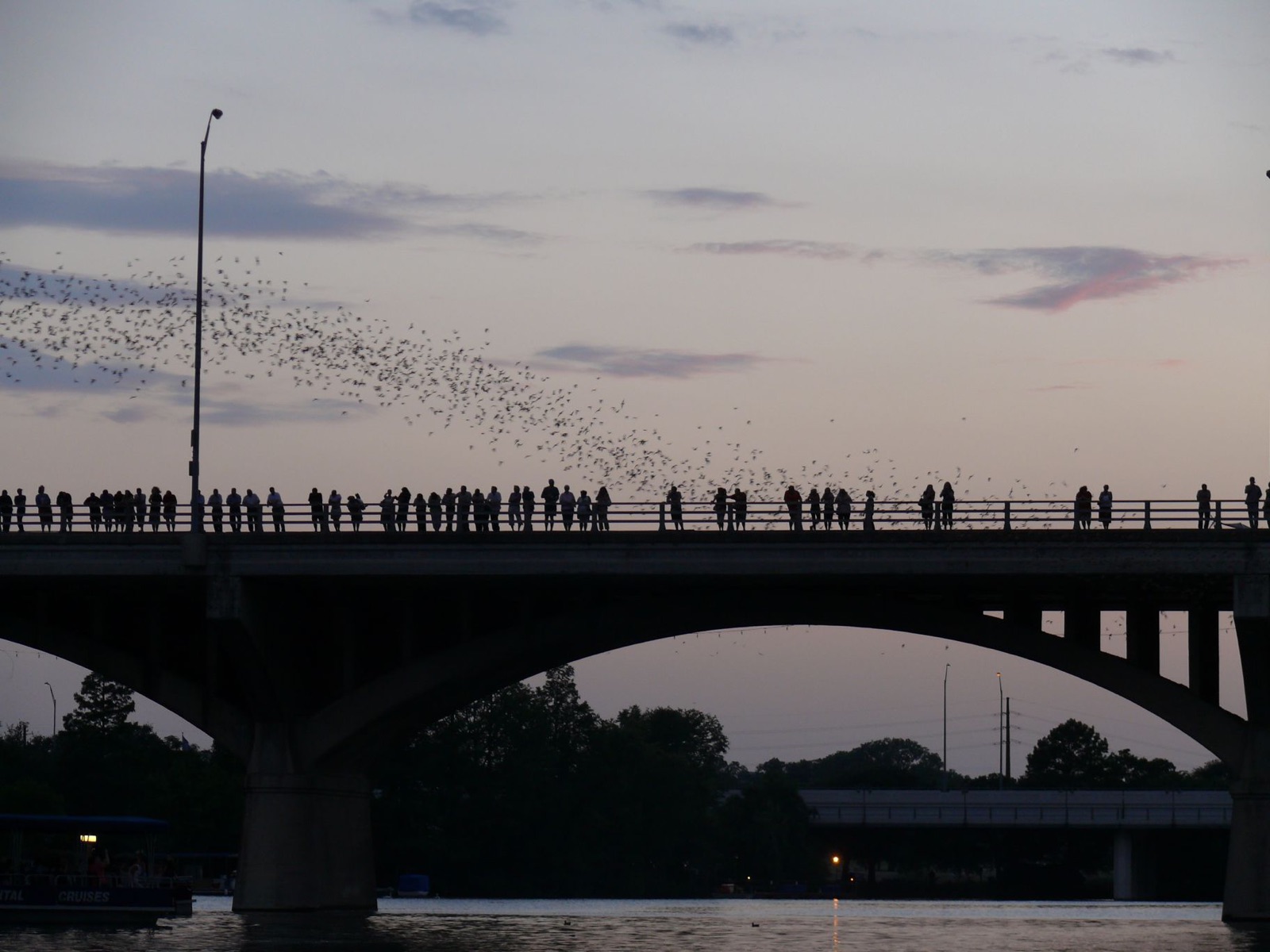
The evening emergence over Lady Bird Lake. About 1.5 million Mexican free-tailed bats roost under the bridge. Photo : Peter Potrowl, Wikimedia Commons, CC BY 3.0.

- Watching the bats. Mid-March to early November, with August the peak month. The colony under Congress Avenue Bridge is estimated at about 1.5 million Mexican free-tailed bats, and the emergence happens at dusk over Lady Bird Lake. Watch from the bridge rail, the Statesman Bat Observation Center on the south bank, or a boat. Our Blanton to bat bridge guide pairs the stays with the sights.
- Swimming. Barton Springs works in every month because it is spring-fed at 68 to 70 °F, but June to September is when 70 °F water is the point rather than a dare.
- Live music. Any month. Austin's venues do not run on a season. March and October concentrate the touring acts, January and February concentrate the local ones, and the latter is easier to get into.
- Wildflowers and Hill Country drives. Late March to mid-April, peaking in early April.
- Kayaking and paddleboarding Lady Bird Lake. April, May, October and November. In July, go at 7 a.m. or not at all.
- Barbecue queues. Any month except July and August, when standing outdoors for two hours is a poor use of a holiday. Weekdays beat weekends everywhere.
- Value. Late January, early February and the second half of September. All three combine soft rates with usable weather.

Barton Springs holds 68 to 70 °F all year, which makes it the one Austin attraction that works best in August. Illustration : Discover Austin's Luxury Hotels: Book Premium Stays Online.
Events that shape the year
Austin is a festival city with a limited room supply, so a handful of dates move the whole market. These are the ones to check before you book.
- SXSW, March 15 to 21, 2027. Film and TV, music, and the conference, across downtown. The most expensive week of the year. See our hotels near SXSW.
- Bluebonnet season, late March into April, peaking in early April.
- Juneteenth, June 19, with events across east Austin. Our June agenda lists what is on.
- Austin City Limits Music Festival, October 2 to 4 and October 9 to 11, 2026, at Zilker Park. Two weekends, about 450,000 attendances, 11 a.m. to 10 p.m. daily.
- Formula 1 United States Grand Prix, October 22 to 25, 2026, at Circuit of the Americas. Our Grand Prix neighborhood playbook covers where to base yourself.
The rule of thumb: in March and October, book three to six months out or pick different dates. In January, February, July and August, book late and negotiate.
Live music has no season in Austin. January and February are the easiest months to get into a room. Illustration : Discover Austin's Luxury Hotels: Book Premium Stays Online.
Where to stay
Neighborhood matters more in Austin than star rating, because the seasons are lived in different parts of town. Downtown puts you on Lady Bird Lake and within walking distance of the bat bridge and the music district. South Congress is the walkable, low-rise side. Four properties from our selection:
- Four Seasons Hotel Austin, 98 San Jacinto Boulevard, downtown. A low-rise 135 room hotel on lawns that run to Lady Bird Lake, with the front door opening onto the hike-and-bike trail. The best address in the city for an April or October trip built around the water.
- South Congress Hotel, 1603 South Congress Avenue. Eighty-three rooms above ground-floor shops, with the courtyard open to the sidewalk. Walkable South Congress is the argument, which matters most in the months when walking is pleasant.
- Hotel San José, 1316 South Congress Avenue. Thirty-nine rooms in a nineteen thirties motor court reworked by Lake Flato, arranged around a courtyard. Shade and a small pool rather than scale, which suits a July stay better than a tower does.
- Fairmont Austin, 101 Red River Street. A thirty-plus storey tower at Waller Creek and the largest Fairmont in the United States, with 813 rooms, five restaurants and bars, a spa and a pool terrace. Scale is the point in a sold-out October week.
For the district-by-district version, see Austin neighborhoods.
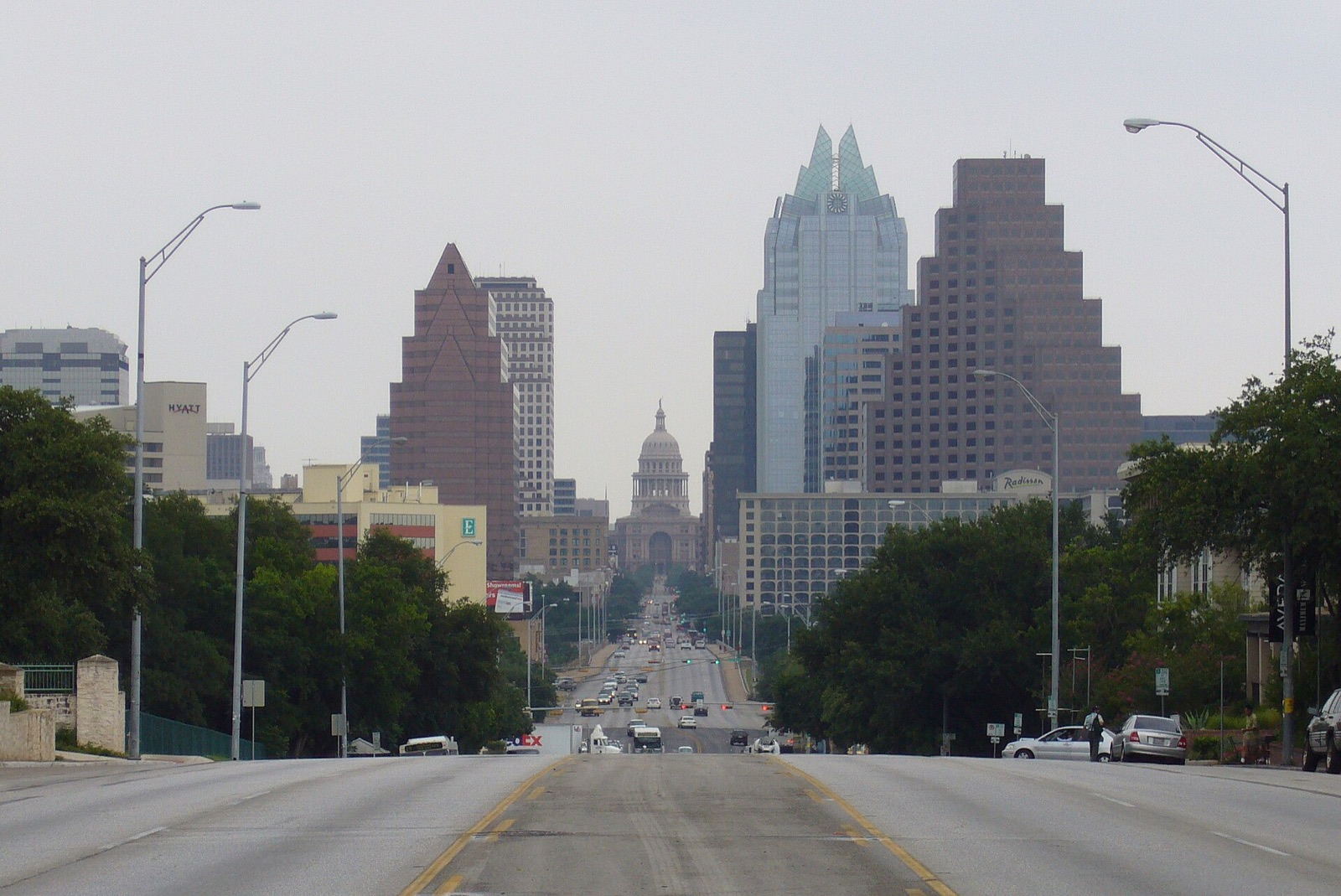
South Congress looking toward the Capitol. The low-rise, walkable side of town, at its best from October to May. Photo : Utexas06 at English Wikipedia, Wikimedia Commons, Public domain.

FAQ
What is the best month to visit Austin, Texas?
April. The average high is 80 °F (27 °C) and the average low 56 °F (13 °C), rain is moderate at 2.4 in (61 mm), and the Hill Country bluebonnets peak in the first half of the month. October is the close second for weather at 83 °F (28 °C), but it carries both ACL weekends and the Grand Prix, so rooms cost far more.
What is the cheapest month to go to Austin?
January, followed by July and August. January combines the year's lowest average high, 62 °F (17 °C), with no major festival. Midsummer is cheap for the opposite reason: an average high of 96 to 97 °F (36 °C) keeps leisure demand down. Citywide occupancy ran around 63 percent in 2025, against 80 to 90 percent in event weeks.
What is the rainy season in Austin?
There are two. May is the wettest month at 5.0 in (127 mm) over about five rain days, from spring thunderstorms. October is the second peak at 4.3 in (108 mm). The dry core is midsummer: August takes only 2.5 in (63 mm) across 2.8 rain days, the fewest of the year. February is the driest month overall at 1.9 in (48 mm).
How hot does Austin actually get in summer?
August averages 97 °F (36 °C) by day and 73 °F (23 °C) at night, and Camp Mabry, Austin's official station, averages 29 days a year at or above 100 °F (38 °C) in the 1991 to 2020 normals. Humidity is the compounding factor: the overnight low does not drop below 71 °F from June to August, so nothing cools off.
When can you see the bats in Austin?
From roughly mid-March to early November, every evening at dusk, from the Congress Avenue Bridge over Lady Bird Lake. The colony is estimated at about 1.5 million Mexican free-tailed bats and is largest in August, after the pups can fly. It empties out in early November when the bats return to Mexico for winter.
When do the bluebonnets bloom near Austin?
Blooms start in Central Texas toward the end of March, and the Lady Bird Johnson Wildflower Center places peak bloom in early April. The window typically runs two to three weeks and moves with the previous winter's rainfall. The best drives are northwest of the city toward Marble Falls, Burnet and Llano.
Should I avoid Austin during SXSW and ACL?
Yes, unless you hold a badge or a wristband. During SXSW 2024, downtown Austin recorded 114,933 occupied room nights at an average daily rate of $423.95, per the Austin American-Statesman. For October 2024, KXAN put the citywide average at $477 a night with 80 to 90 percent occupancy. The weather in those weeks is good; the value is not.
Does it snow in Austin?
Effectively no. The NOAA 1991 to 2020 normals record no snowfall in any month at Austin-Bergstrom. The winter hazard in Central Texas is freezing rain: the ice storm of January 31 to February 2, 2023 cut power to more than 170,000 Austin Energy customers and brought down trees across the city. It is uncommon, but it argues for refundable February rates.
Read next
- Surviving Austin's summer, the pools, springs and lake escapes that make July workable.
- September is Austin's real luxury season, a shoulder-season booking strategy.
- The F1 weekend neighborhood playbook.
- Booking Austin in July, the heat strategy and the rates worth paying.
- Where to stay in Austin, by neighborhood and trip type.